
Team Members
A Team Member is a Person to whom you've granted special permission to use the Admin Dashboard and/or the Solidarity app.
Every Team Member is assigned a Role, with a set of Permissions that determine what they can and can't see and do as administrators, and a Scope. By default, the account creator gets the Admin User role at the root organization. This role can use every permission on the platform. The lowest of these default roles, Volunteer User, gives that team member access only to the workflows you invite them to.
The number of Team Members that you can have is determined by your Billing Plan. People can be added or removed as Team Members at any time.
Person vs. Team Member vs. Solidarity Account
There are three distinct concepts at play. A team member cannot log in until all three are in place.
| Concept | What it is | Can they log in? |
|---|---|---|
| Person | A contact record in your database (anyone who signed up, was imported, or was added manually) | No |
| Team Member | A Person you have explicitly added to your team and assigned a Role and Scope | Not yet, in most cases. They still need to create their Solidarity Account, unless their email already has one. |
| Solidarity Account | The email and password a Team Member creates after clicking their invitation link | Yes. This is the login for the Admin Dashboard. |
Key point: Having someone in your People database does not give them login access. You must add them as a Team Member first, which sends them an invitation. They then use that invitation to create their Solidarity Account (email + password). Only after completing that step can they log in or reset their password.
How to Give Someone Dashboard or App Access
When you first sign up and open the admin dashboard, an overlay asks you to invite Team Members. Enter their email addresses, assign them a default Role, and invite them. You can also give access with one of the two options below.
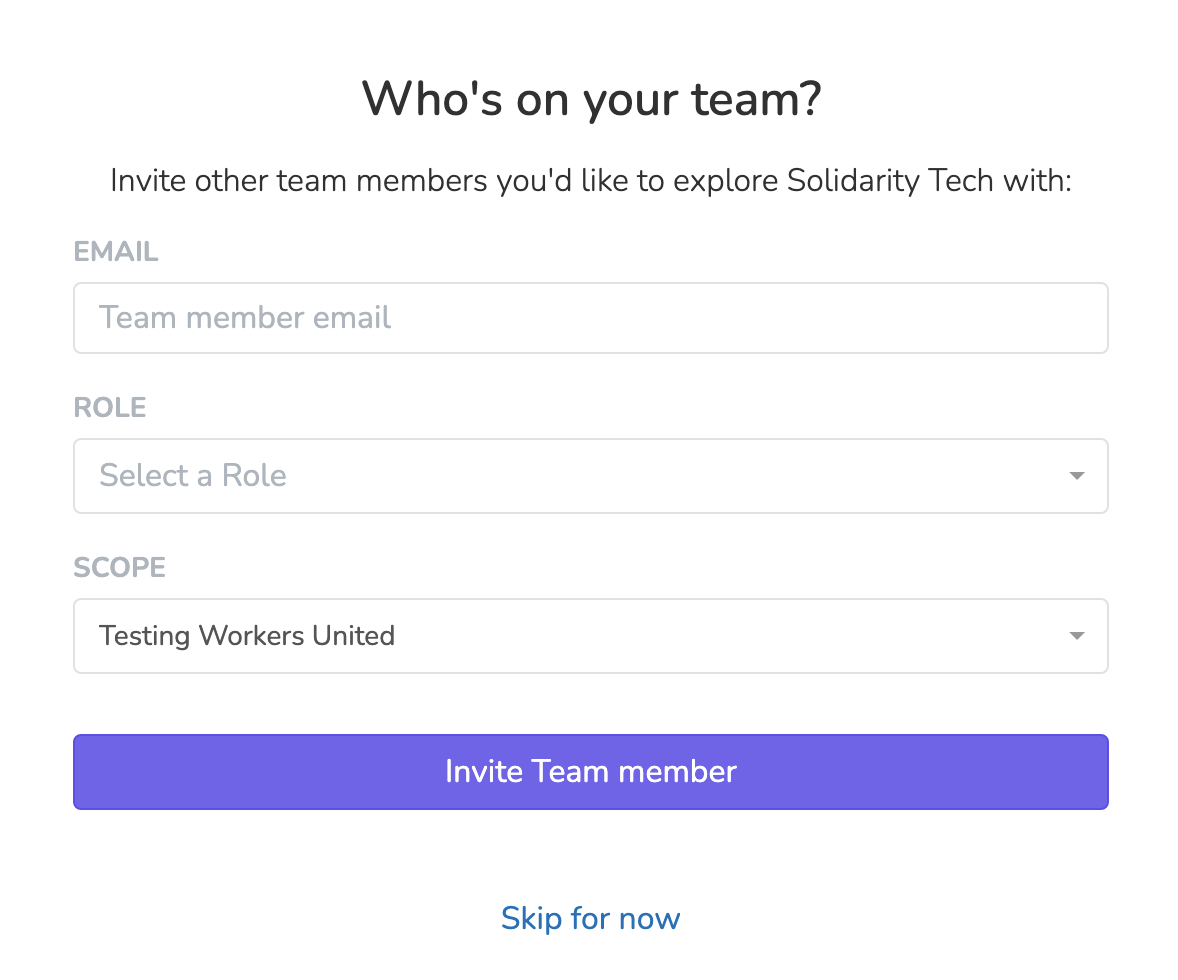
Option 1: Add from the Manage Team Page
- Go to Settings → Team in the Admin Dashboard
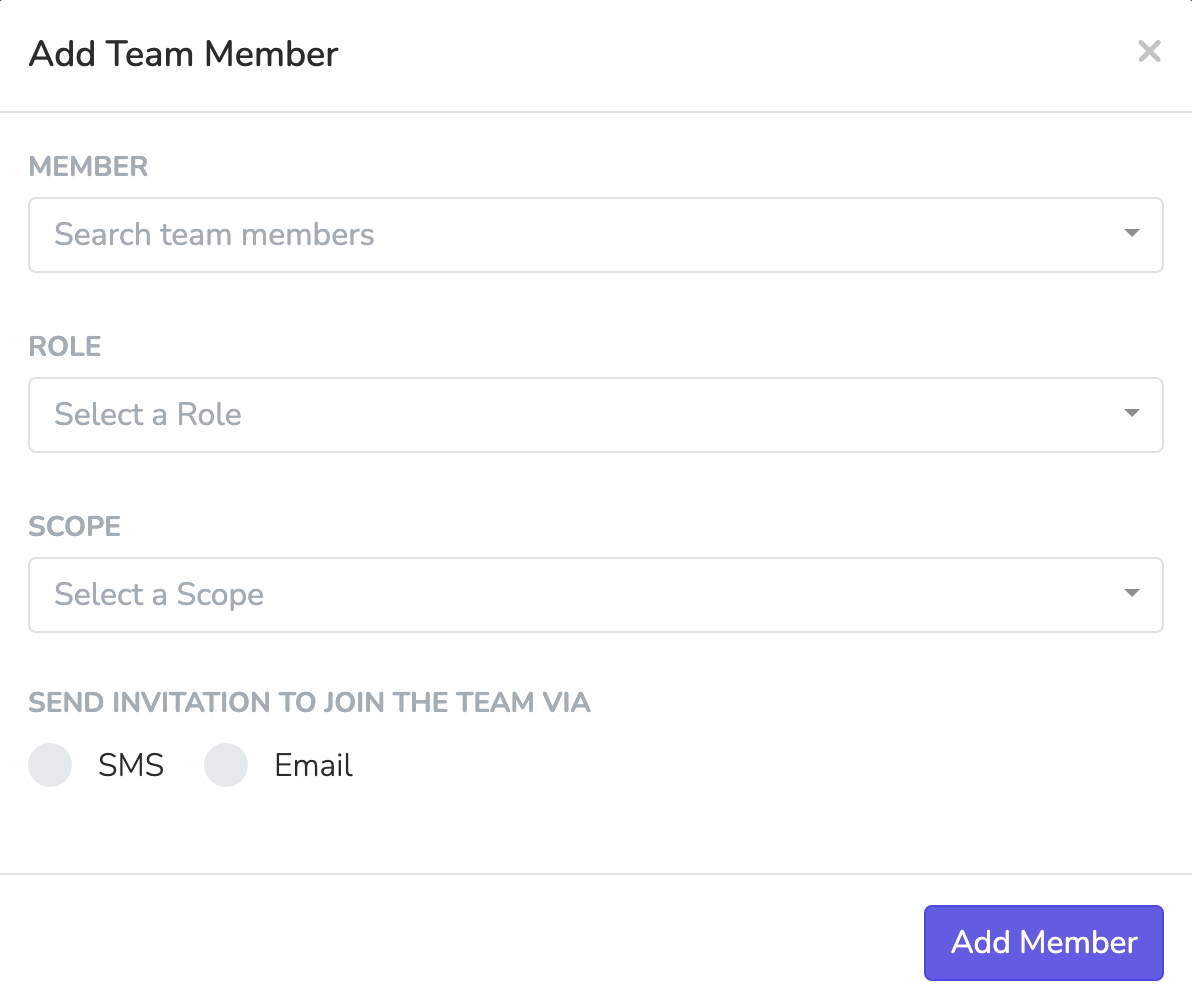
- Click the Add team member button
- In the Member field, search for and select the person. If the person is not in People, click Invite by email under "Can't find them?" and enter their Email Address, First Name, and Last Name. Solidarity Tech adds the person to People.
- Choose a Role (determines what permissions they have) and a Scope (determines what data they can see)
- Choose whether to send the invitation via SMS or Email
- Click Add team member.
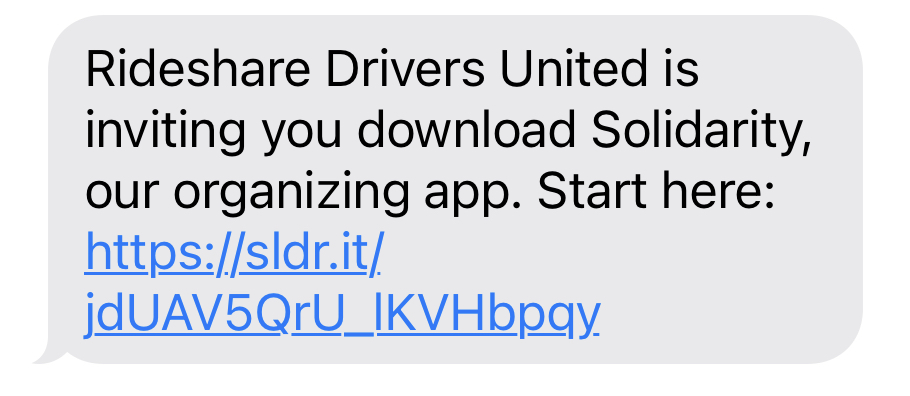
The Person will receive a text or email with a special invitation link. When they click the link, the join page asks them to create their Solidarity Account with a password. For an SMS invitation, they also enter their email. These credentials are what they will use to log in to both the Admin Dashboard and the Solidarity app. If they already have a Solidarity Account with another organization, they can join your team with just a click.
Option 2: Magic Link (for Phonebanks and Textbanks)
If you are setting up a phonebank or textbank, you can generate a magic link that you share directly with your volunteers. When someone opens the magic link, they can create their Person record, Team Membership, and Solidarity Account in a single step.
Checking Team Member Status
You can see the status of every Team Member from the Manage Team page (Settings → Team). A filter dropdown shows everyone in your scope, only those who are Invited and have not created their Solidarity Account, or Everyone with access, which adds team members whose access comes from a parent organization.
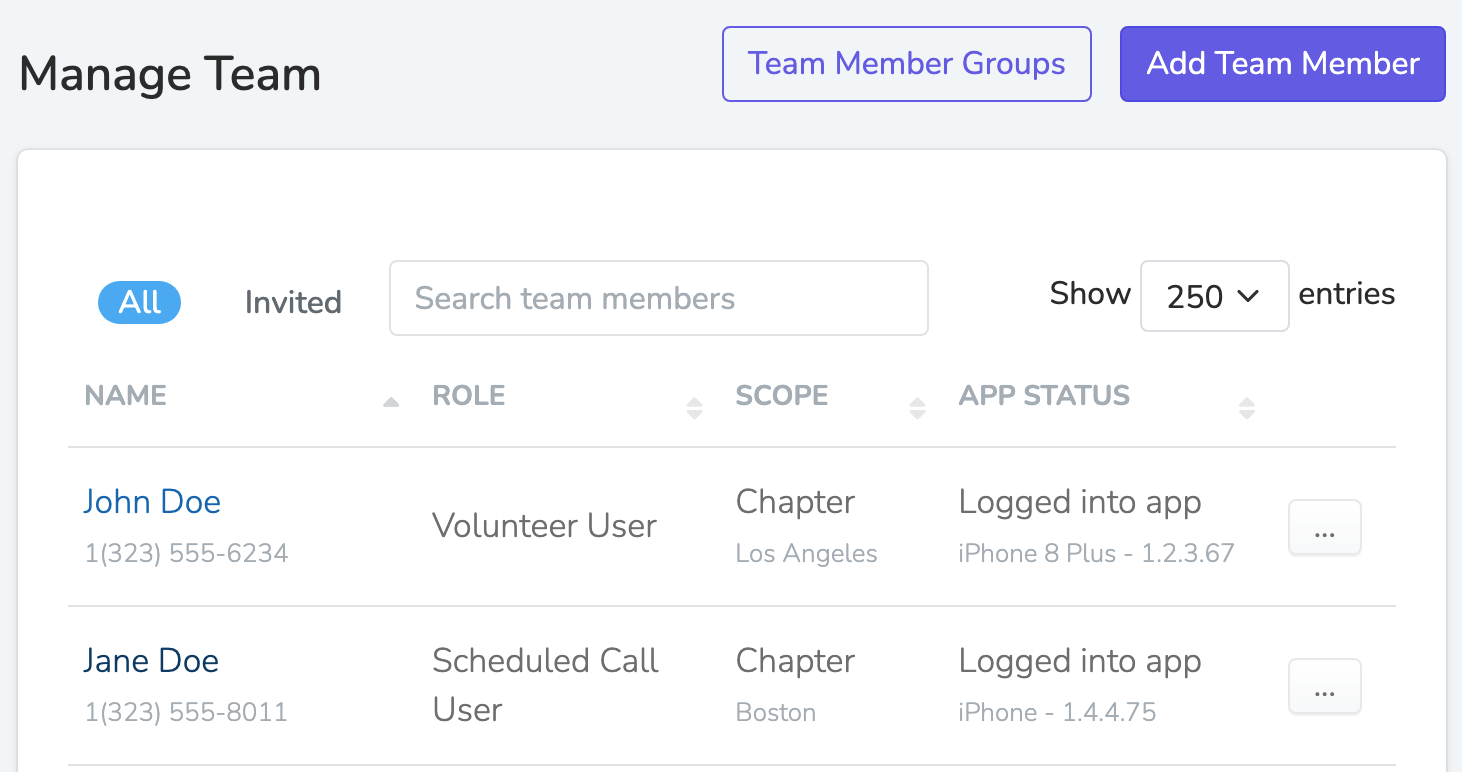
The App Status column shows Invited to Join Team (no Solidarity Account yet, cannot log in), Accepted Team Invitation (can log in to the dashboard, has not logged into the app), or Logged into app.
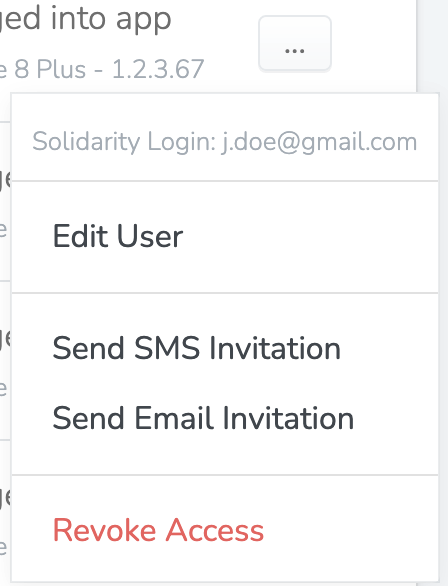
Click the "..." button next to a name to manage that team member. If they have a Solidarity Account, the top of the menu shows "Solidarity Login: [email protected]". From this menu you can edit their role and scope, resend the SMS or email invitation, Impersonate them, or Revoke Access.
Impersonating a Team Member
Team members with the Admin User role or the Impersonate Team Members permission can view the dashboard as another team member in their scope, for example to troubleshoot access issues. Click the "..." menu next to the team member and select Impersonate. A banner then shows whose account you are viewing, with a Stop Impersonating button.
You can only impersonate team members whose every assignment falls within your own scope. Unless you are the account owner, you cannot impersonate someone with a higher or equal role at the same scope. Team members who have not accepted their invitation cannot be impersonated.
Note: Because impersonation signs you in as another user, all dashboard activity during that session (notes, edits, exports) is recorded under their name. Use this feature only when necessary for support or troubleshooting purposes.
Troubleshooting: "My Team Member Can't Log In"
| Problem | Likely Cause | Solution |
|---|---|---|
| "They can't log in and password reset emails aren't arriving" | They were never added as a Team Member, so they don't have a Solidarity Account. | Add them as a Team Member from Settings → Team. Once they complete the invitation, they can log in. |
| "They never got an invitation" or "Their status says 'Invited to Join Team'" | The invitation went to spam or an outdated phone number or email, or they have not clicked the link yet. | Click "..." next to their name and resend the SMS or email invitation. |
| "They created their account but forgot their password" | They have a Solidarity Account. | They open the dashboard login page and click Forgot password?. The reset email goes to the address of their Solidarity Account. |
Understanding Scope
Scope determines what data and resources a Team Member can see. A wrong scope can hide an event, a phonebank, or contacts. When something seems to be missing, check the scope first.
- Each Team Member is assigned a scope when you add them (e.g., the root organization, a specific chapter, or a child organization)
- Lists show the resources of the current scope and the scopes below it. The event list also shows events that name one of those scopes as an approved co-host.
- The currently active scope is shown in the top-left corner of the dashboard. Click it to switch scopes. The dropdown shows only when you have access to more than one organization or more than one chapter.
Tip: The dashboard remembers the scope you last selected. At your next login, it opens in that scope. If you can't find something, check your current scope first and try switching to the root organization.
Managing Your Team
In order to add or remove Team Members, you must have access to the "Manage Team" permission. You can only give or change a role when you hold every permission of that role at that scope. The Team tab in Settings shows only to team members with the View Team permission.
Multiple Roles and Scopes (Professional Plan)
On the Professional plan, team members can have multiple role/scope combinations, called assignments. For example, someone can be Admin User at one chapter and Volunteer User at another. To add one, click the "..." menu on a team member, select Edit Team Member, and add an assignment with its own Role and Scope.
Permissions combine only across the assignments whose scope covers the current scope. A permission from an assignment at another chapter does not apply while they work in this one. To see the resources of another assigned scope, they switch to it with the scope selector.
Team Member Groups
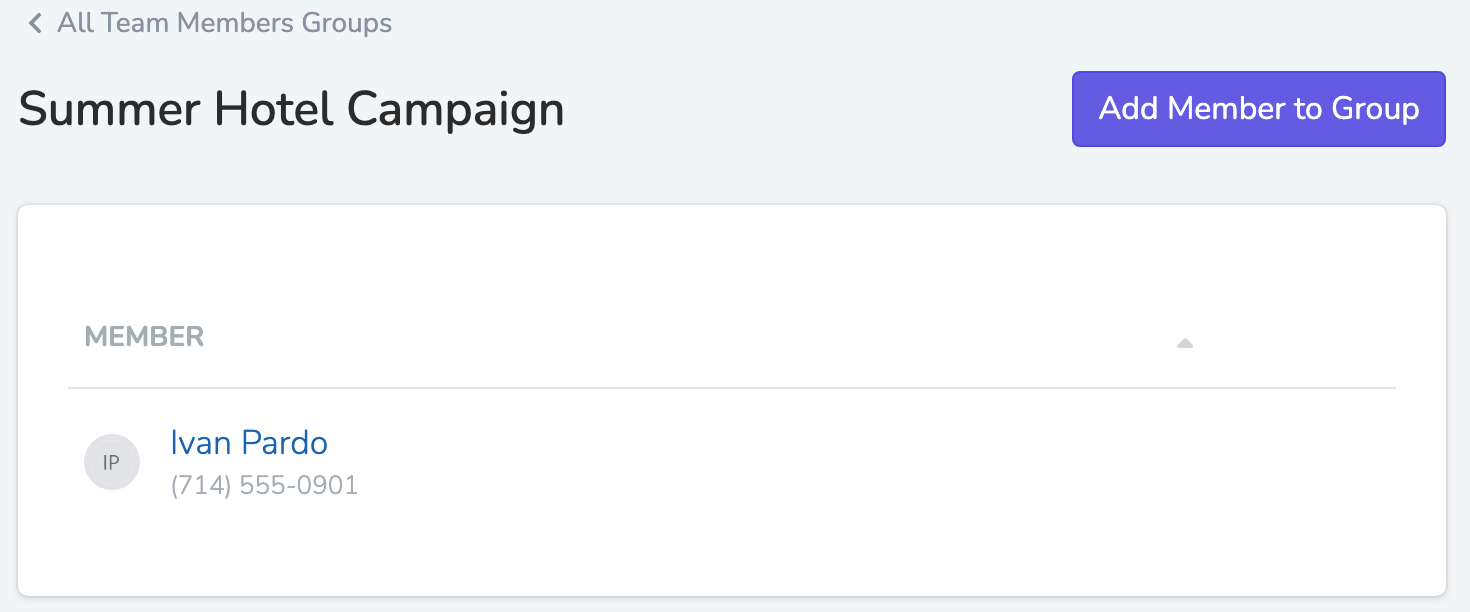
Sometimes it makes sense to group Team Members together if for example, they are all working on a temporary campaign, or if you want to measure their progress collectively. To create a group and add team members to it, go to Settings → Team and click Team member groups. Groups need the Standard, Professional, or Enterprise plan and the Manage Team permission.
Updated 2 days ago